Fantasy is the oldest and most creative genre of storytelling. It allows authors to take the mundane world around us and transform it into something magical, with daring heroes who represent the best of human virtues, monsters who represent the worst of our fears, and mystical phenomena that can do everything from summoning fire from nothing to re-writing reality itself. It is limited only by the imagination of the storyteller, and can be represented in countless ways, from epic high fantasy quests to urban fantasy where magic hides in plain sight.
When it comes to movies, fantasy has been through several periods of ups and downs. The 2020s have been somewhere in the middle, with a few stand-out movies that grab audiences with their impressive worlds and thought-provoking themes.
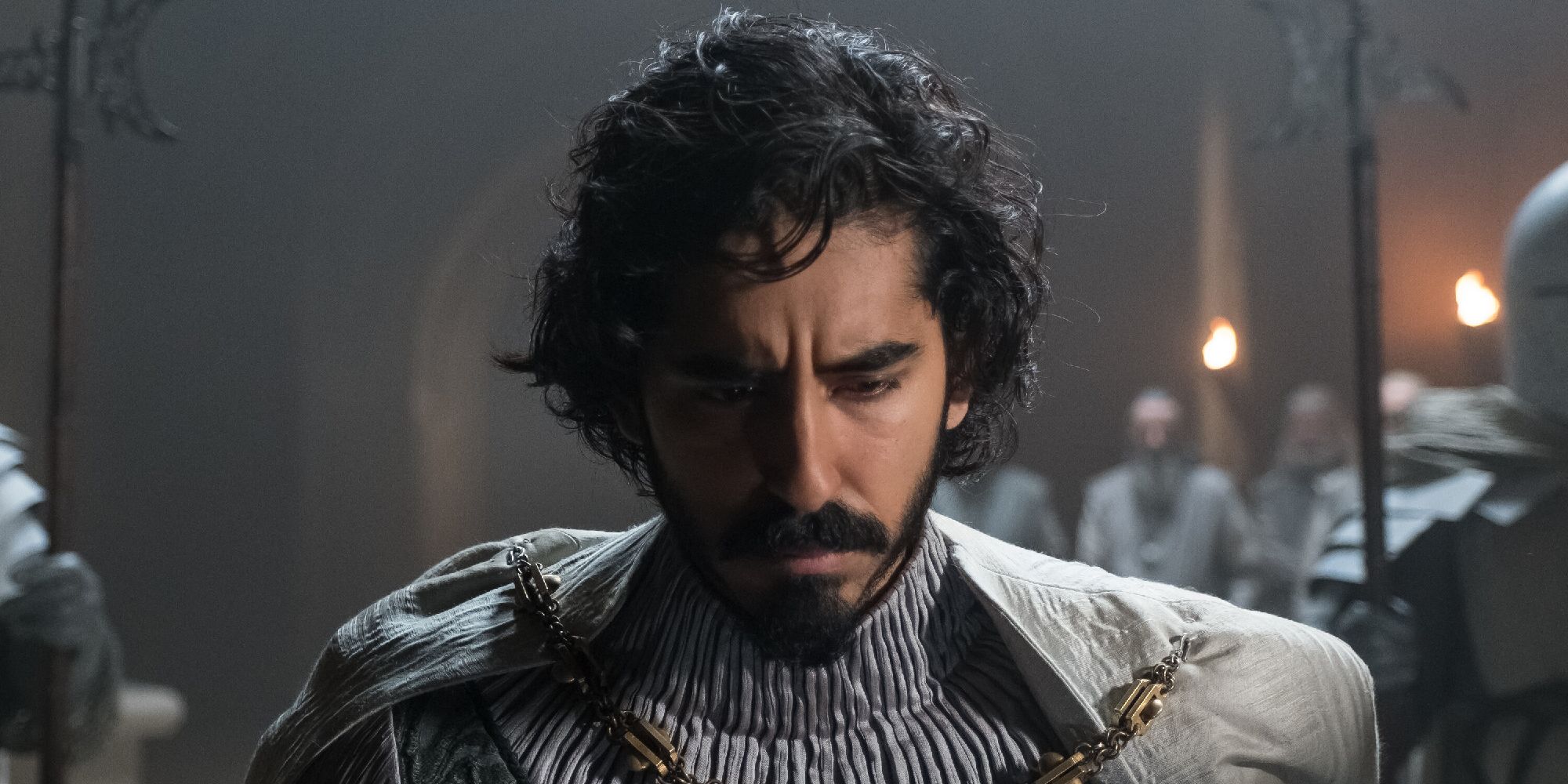
On Christmas Day, a mysterious Green Knight (Ralph Ineson) barges into the court of King Arthur (Sean Harris) with a challenge: any knight who lands a blow on him will receive his axe, but must seek out the knight in one year's time to receive the same blow. Sir Gawain (Dev Patel) takes up the offer and decapitates the knight, who picks up his head and rides off. One year later, Gawain sets off to uphold his end of the bargain, but the road is long and full of perils, both mundane and magical in nature.
The greatest strength of The Green Knight is how it makes its world feel truly magical. Nobody slings powerful spells or wields otherworldly weapons, but every step in Gawain's journey feels like one has entered into an enchanted dream, where unseen forces push and pull against each other. Thus, when the magical creatures like the Green Knight show up, it feels like the hidden forces have finally come to the foreground. Patel's performance as Gawain is also stellar: he truly feels like a young man full of human flaws and completely out of his depth, yet he keeps pushing forward because he has a duty to uphold.
Robyn Goodfellow (Honor Kneafsey) is the adventurous daughter of Bill (Sean Bean), a wolf hunter who has been employed by the Lord Protector (Simon McBurney) of Kilkenny to drive out the wolves from the local forest. While trying to help Bill, she gets caught in one of Bill's traps, and meets Mehb (Eva Whittaker), a feral girl who identifies herself as a Wolfwalker; someone whose spirit can leave their human body and become a wolf. Unfortunately, Mehb accidentally bit Robyn while freeing her from the trap, transforming her into a Wolfwalker as well.
Wolfwalker is the final of Cartoon Saloon's Irish Mythology Trilogy, and though not as strong as the first two entries, it's still a beautiful movie. The animation is stellar: it continues the trilogy's aesthetic of medieval illustrations come to life, but takes it even further through first-person perspectives that let audiences see the world through a wolf's POV, both through sight and smell. It also makes a great distinction between the lush, deep colors of the forest, and the stale uniformity of the city. The story and characters are also solid, with themes of individual expressions, the natural world's attempt to survive against human expansion, and even the dangers of pride through the Lord Protector's stubborn adherence to what he believes is a just cause.
Rumi (Arden Cho), Mira (May Hong), and Zoey (Ji-young Yoo), are members of the famous k-pop band Huntrix, but, unknown to their millions of fans, they use the power of their support to battle evil demons and create a magic barrier to keep the demons from invading the world. Realizing this, demon king Gwi-Ma (Lee Byung-hun) creates a boy band called the Saja Boys to steal their fans. Their leader, a former human named Jinu (Ahn Hyo-seop), further complicates things when he discovers that Runi is a half-demon, and the two begin taking great risks as they open up to the other.
KPop Demon Hunters became one of Netflix's biggest hits, attracting fans from all demographics. This is thanks to how simple but deep the film is. It doesn't break new ground in any way, but every element, from its catchy songs to its gorgeous animation and sense of humor, is good enough that, together, they make a world that is an absolute blast to watch. It also helps that the story is really good, focused on themes of overcoming self-doubt and finding acceptance in oneself, even with all of our imperfections.
Four worlds and four completely different ideas of what a good life looks like. This is where you belong, what it would ask of you, and what you would get back in return.
You belong somewhere old enough that the mountains have names and somebody can still tell you who gave them. Middle-earth is for people who think the right thing is worth doing even when it will not be finished in their lifetime.
You want the sea, a crew, and absolutely nobody telling you where you are allowed to go. The Grand Line is the world for people whose main ambition in life is finding out what is over there.
You would rather be feared and useful than liked and useless. The Continent is a world where the monsters are the straightforward part of the job and the people are where it all gets complicated.
You want the myths to be real and loose in the actual world, and you want to find out at about thirteen that you were never anywhere near as ordinary as everybody kept telling you.
Famous swashbuckling outlaw Puss in Boots (Antonio Banderas) learns that he is down to the last of his nine lives, and after a disastrous fight with a mysterious white wolf (Wagner Moura), he resigns himself to an early retirement. His hope is rekindled upon overhearing Goldilocks (Kailey Crawford and Florence Pugh) and the Three Bears (Ray Winstone, Olivia Colman, and Samson Kayo) talk about how Big Jack Horner (John Mulaney) has acquired a map that leads to a fallen wishing star. Teaming up with his old flame, Kitty Softpaws (Salma Hayek Pinault), and an unnamed but very friendly dog (Harvey Guillén), Puss races to claim the wishing star and regain his lost lives, but the shadow of the wolf follows him every step of the way.
Puss in Boots: The Last Wish is the sequel to 2011's Puss in Boots—itself a spin-off to the Shrek franchise—and it blew away audiences and critics with the insane level of talent and passion put into it. The animation alone is phenomenal, drawing heavily from Sony's Spider-Man: Into the Spider-Verse to create a beautiful style that looks like animated watercolor drawings. This fits with the film's fairy tale aesthetic, as it's like a storybook has come to life. Then there is the writing: when it's not making audiences laugh with its clever jokes that continue the franchise's habit of poking fun at classic fairy tale clichés, the film hits hard with a mature story about coming to terms with one's mortality and finding that, oftentimes, the things we want most have been in front of us the entire time.
Consumed by grief over the death of his son, a woodcarver named Geppetto (David Bradley) chops down the tree growing over his grave and carves it into a puppet in his likeness. A passing Wood Sprite (Tilda Swinton) takes pity on him and brings the puppet, named Pinocchio (Gregory Mann), to life, and tasks a cricket named Sebastian (Ewan McGregor) with being his conscience in exchange for a wish. Pinocchio's lack of social awareness and eager personality makes him excited to learn about the world, but it also leaves him vulnerable to the manipulations of numerous groups who want to exploit him for one reason or another.
Guillermo del Toro's Pinocchio was a passion project of the director's for years, and you can feel Del Toro's love and creative spark in every scene. He made a lot of changes from the original Carlo Collodi story, such as setting it in the 1930s, and replacing iconic moments like Pleasure Island with trips to the Underworld where Pinocchio talks to Death (Tilda Swinton). He uses these changes to explore interesting themes like grief, mortality, and the idea that Pinocchio can become a real body without literally transforming into one, which gives the movie a very strong identity. The stop-motion animation is also phenomenal, with plenty of intricate details and impressive movements during action sequences.
After losing his mother to allied firebombing during World War II, Mahito (Soma Santoki/Luca Padovan) finds himself moving to the countryside to live with his aunt and new stepmother, Natsuko (Yoshino Kimura/Gemma Chan). Mahito keeps himself distant from Natsuko and her household staff, but finds himself being stalked by a peculiar Grey Heron (Masaki Suda/Robert Pattinson). The heron eventually leads Mahito inside a ruined tower built by his great granduncle (Shōhei Hino/Mark Hamill), which contains within it a portal to another world.
The Boy and the Heron is the most recent film to come from legendary Japanese director Hayaou Miyazaki, and became his second movie to win the Academy Award for Best Animated Feature. It's perhaps the most dream-like of all his movies, especially once the characters get to the other world. Every character and location is metaphorical for aspects of the difficulties Mahito is experiencing, leading to strong themes regarding grief, loss, and the next generation trying to build a better world than the one from before. Finally, the English voice cast for the film is great, made up of veteran actors from previous dubs of Studio Ghibli films, and newcommers like Pattinson, who sounds completely unrecognizable as the heron.