The Lord of the Rings: The Rings of Power showed how the peaceful, sleepy region of Middle-earth known as the Southlands became Mordor, the seat of power for the Great Evil that defined the Third Age. J.R.R. Tolkien never offered much insight into Mordor before Sauron turned the region into a smoking hub of villainy, and while The Rings of Power tried valiantly to hide its big twist, plenty of viewers quickly deduced the Southlands was actually Second Age Mordor.
Essentially, an ancient key switches on a dormant Southlands volcano. The resulting cataclysm brings forth ash, steam, fire, rock, water, and, most of all, misery, and by the end of The Rings of Power season 2, the transformation of the Southlands is well underway. However, even for a being as powerful as Sauron, morphing a relatively pleasant land of plains and mountains into hell on Middle-earth is no simple feat. One does not simply turn the Southlands into Mordor — it's a process of epic proportions that begins with a disgruntled tavern owner and ends with a permanent scar upon the map.
The — quite literal — key to turning the Southlands into Mordor proves to be the broken black sword kept hidden by Morgoth loyalist Waldreg. The weapon slots into an ornate hole at the Elven watchtower of Ostirith and begins a chain of events that give rise to Mordor — but who constructed this mechanism, and for what purpose?
Although Ostirith is occupied by Elves when The Rings of Power begins, the magical black sword and skull mechanism obviously aren't their doing. The Southlands fought for Morgoth during the War of Wrath, so Ostirith was once under the control of the dark forces of Middle-earth, meaning the sinister key and its corresponding doom-switch were likely forged during this period.
It can also be assumed this dark machinery built into the mountain wasn't just for some mundane purpose like opening the dam or changing water levels. Not even a showman like Sauron would craft a magic black sword with a giant skull lock for such an ordinary reason. Whoever made this lock-and-key combo apparently had the formation of Mordor in mind from the beginning.
The Rings of Power hasn't yet offered enough information to say whose mind the Mordor master plan originated from. The black sword dates back to Morgoth, but Morgoth wasn't the type to plan for his own downfall, which leans more toward Sauron as the chief architect. The Southlands-shaped sigil on Finrod's corpse proves Sauron held an interest in the area for centuries, and the Lord of the Rings villain could've carried out his designs in secret.
Going into Rings of Power season 3, Sauron's evil kingdom is fully established, and he is set to forge the One Ring in the fires of Mount Doom. As this story continues, the show may provide further details regarding Sauron's overarching plan for the Southlands, including when he first set to work on the idea and just how much came from his own mind.
The Rings of Power's Ostirith tower is located on the eastern side of the Ephel Dúath mountain range (red circle on the map above), meaning the offending waterway could be either the Poros or some tributary of Middle-earth's huge River Anduin. Regardless, turning the black sword lowers the wall holding this water back, and the cascade courses down the rocky cliff, destroying part of Ostirith's battlements along the way (further proof that the release system wasn't designed for regular dam control).
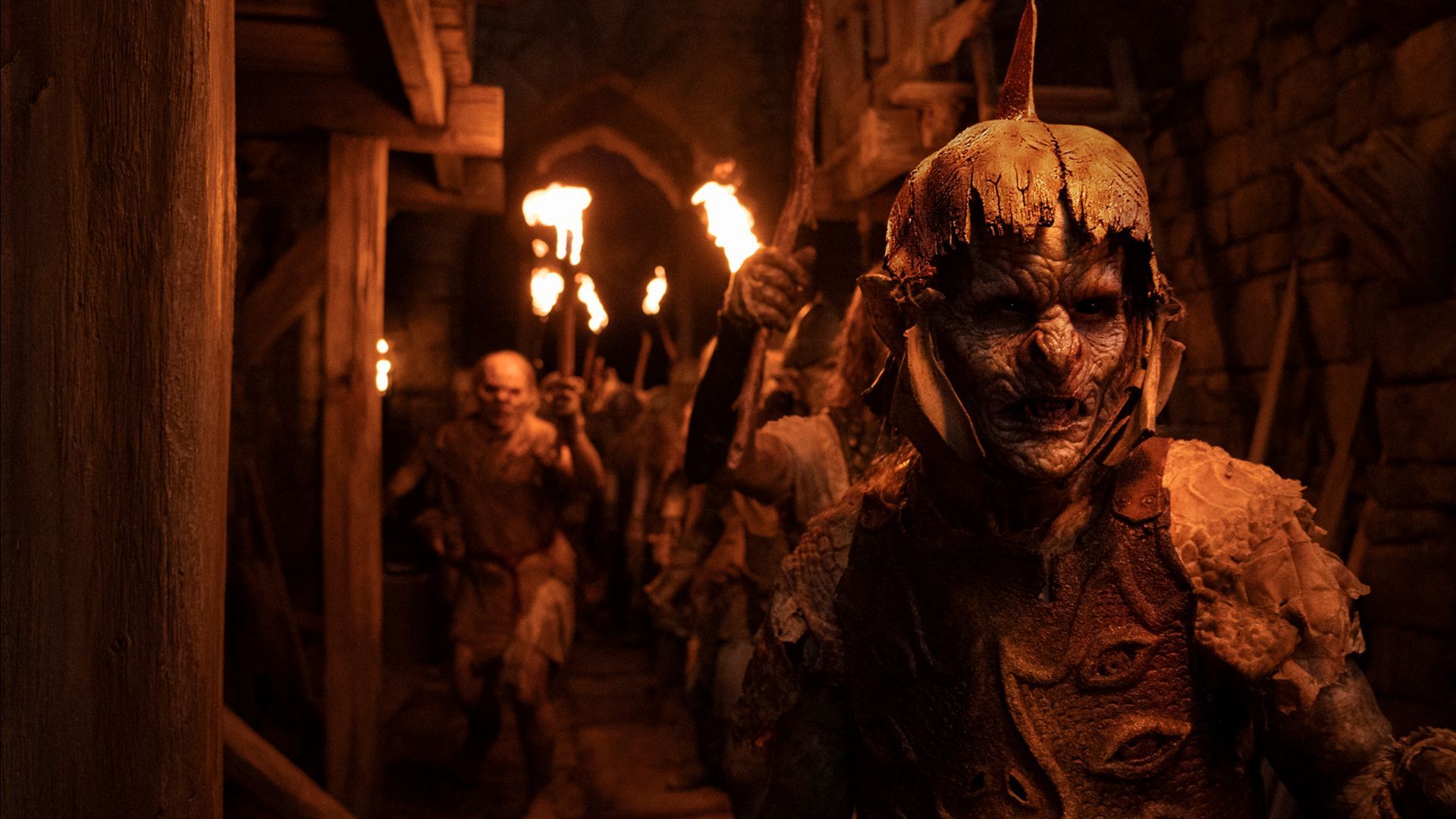
Once the water hits the bottom level, it flows into a cavern and through a system of tunnels and trenches. These are the very same tunnels and trenches that Adar's Orcs have been digging ever since their Southlands invasion began. Their purpose, as confirmed in The Rings of Power season 1, episode 6, was to direct the flow of river water along a specific course through the Southlands.
Thanks to the scenes of destruction witnessed by Galadriel and the other victorious warriors, it's known that the water passes through the village Tirharad (yellow circle), as well as Hordern (green circle), which was excavated by Orcs earlier in The Rings of Power. All the various underground tunnels feed into a central overground trench dug by Arondir and the other prisoners, which carries the water north to an inactive volcano — the future Mount Doom.
Weirdly for a world that boasts immortal wizards and ghost armies, The Rings of Power's volcanic eruption is more or less plausible, scientifically speaking. The meeting of cool water released from Ostirith with the magma bubbling peacefully beneath Halbrand's Southlands kingdom creates a massive amount of steam within a confined space, which in turn leads to a violent phreatomagmatic eruption churning out magma, ash, and pyroclastic fragments, as well as generating extraordinary heat.
Even the thunderstorms triggered within the eruption's ash cloud are semi-based in scientific fact, since such weather typically occurs due to warm air and water particles rising. Warm air and water are exactly what's rising in The Rings of Power's explosive season 1, episode 6 ending, so while the thunderstorms may happen very quickly, they're not just present for dramatic flair.
Identify the cover art while scratching off as little foil as possible.
Sign in to claim your place on the leaderboard!
It's also important to remember that this particular eruption was triggered by a magic black sword, so there's very likely an element of sorcery to The Rings of Power's volcano compared against real-world phreatomagmatic eruptions. Mount Doom is, after all, where Sauron's One Ring will be crafted, making it special even within the context of Middle-earth. The eruption itself may be triggered by science, but one cannot rule out Morgoth or Sauron weaving a touch of dark magic into the process.
The main purpose of The Rings of Power's eruption — at least for Adar — is generating a massive plume of steam and ash that covers the sky, thus blocking out all sunlight, which Orcs have a bad allergic reaction to. Even during Frodo's journey, Mordor is renowned as a realm cloaked in darkness, and those days begin when Waldreg turns the sword-key in The Rings of Power.
Darkness isn't the only outcome of Adar's Southlands transformation project, however. Where Orcs tunneled upwards into settlements such as Tirharad and Hordern, water now bursts through the cavities, turning the Southlands' smooth plains into Mordor's craggy landscape. The trench carved out by Adar's prisoners isn't vanishing anytime soon either, leaving a huge permanent gash all the way from Ostirith to Mount Doom. Any Southlanders who think they could endure a few potholes and a surprise river should think again.
The flying rocks and clouds of steam emanating from Mount Doom's eruption will destroy settlements, while the oppressive heat will make living and farming in the area all but impossible. Even during the War of the Ring, Mordor is largely inhospitable for any race but Orcs, and intense heat isn't the only factor behind the Southlands' newly-barren landscape — the volcanic activity could produce sulfur dioxide, stunting nearby plant growth.
In many ways it's obvious why the Southlands becoming Mordor in The Rings of Power is important. Mordor is, after all, the final destination of Frodo's quest in The Lord of the Rings, and where the final battle against Sauron takes place in both of the wars against him. However, there are some important points to consider when it comes to the impact the change had in-universe for the citizens of Middle-earth who existed beyond the Southlands themselves.
Thanks to Morgoth, the races of Middle-earth were no strangers to threat. However, once Mordor was created, the danger existed right on their doorstep in a way it never had before. Perhaps only the dwarfs, whose digging beneath their fortress-cities brought them forever close to some of the more dangerous creatures of Middle-earth, knew how to exist with evil so close and (literally) on the horizon.
Being able to see the fiery Mount Doom on the skyline would have brought evil closer to the hearts and homes of most of the inhabitants of Middle-earth in a way few would have known before (especially humanity). For those alive during the creation of Mordor in The Lord of the Rings: The Rings of Power, the time prior to the eruption of Mount Doom would likely come to be known as an era of, if not literal peace, but peace of mind at the very least, and one that wouldn't be seen again for many, many millennia.
Set in the Second Age of Middle-earth, The Rings of Power explores the forging of the iconic rings, the rise of the Dark Lord Sauron, and the epic events leading up to the stories in J.R.R. Tolkien's classic novels.