Greer Riddell is a London-based culture journalist and critic writing on film, television, audience behaviour, and the wider media industry. She is a Writer and Social Media Coordinator at Collider and TV Editor at FILMHOUNDS.
Her recent collaborations include Netflix, Warner Bros., DC Studios, Hulu, and Disney+, producing features on titles including Saturday Night Live UK, Severance, Sitcoms, Buffy the Vampire Slayer, and Stranger Things. Her recent reviews include Peaky Blinders: The Immortal Man, Stranger Things: Tales From ‘85’, Scrubs Season 10, and The Boroughs. Her work has also included coverage of UK film festivals and features published in Film Stories Magazine.
One of the most talked-about differences between Saturday Night Live UK and the American original is that the British version has the freedom to swear. That might seem like a relatively minor distinction between two versions of the same format, but language can affect the rhythm of a joke, the impact a character has, and the level of realism a sketch can achieve. However, the British version of Saturday Night Live has used that freedom sparingly since launch. Should it be making more of it? With swearing as much a part of British humor as satire, the prospect of a more unrestrained American show seems straightforward, but the writers need to consider whether swearing actually makes the show funnier or whether it just reaching for an easy punchline.
In the U.K., the television watershed starts at 9 p.m.; any TV shows airing before that time should be suitable for broadcast to children. Ofcom’s Broadcasting Code states that the strongest language must not be broadcast before that point and that offensive language must be justified by context. The transition should not be abrupt, with the rules taking into account the likely audience and viewers’ expectations. That framework gives a late-night show such as SNL UK, which airs at 10 p.m., room to use language that would be much harder to accommodate on American network television.
Four of the largest communities on the planet, and four completely different reasons to belong to one. Here is yours, what it would give you, and the argument you would be having within a week.
You belong to the fandom that is really about comfort. Hogwarts works on people because it is a place rather than a plot, and the pull is not the wizard war so much as the corridors, the food, the weather and the sense that somebody is expecting you.
You belong to the deepest fandom on this list, the one where somebody has always read further than you and is quietly delighted to say so. Middle-earth rewards patience more than any other world in popular culture.
You belong to the loudest and largest tent of the four, the one where three generations are all watching the same thing and none of them agree about any of it. That disagreement is not a flaw in this fandom, it is the main activity.
You belong to the thinking fandom, the one that turns up for the argument rather than the explosion. Trek has always been a series of ethical problems in space, and the people who love it love being asked what they would have done.
On NBC, where Saturday Night Live airs, the network has to abide by the rules set by the Federal Communications Commission (FCC). These rules restrict indecent and profane material on broadcast television between 6 a.m. and 10 p.m. The restrictions are not a blanket prohibition on every swear word in every context, but they create a significant constraint for a live comedy program. SNL also faces a particular complication due to geography, because its live East Coast broadcast takes place far later than on the West Coast. The simultaneous West Coast broadcast airs at 8:30 p.m., before the FCC’s safe-harbor period begins at 10 p.m.
Saturday Night Live learned the consequences of an on-air slip the hard way. In 1981, cast member Charles Rocket said, “I’d like to know who fucking did it,” at the end of a sketch built around the Dallas “Who Shot J.R.?” storyline. He subsequently lost his job, while executive producer Jean Doumanian was also dismissed amid wider problems during Season 6. However, later on-air slips by performers, including Paul Shaffer, Kristen Stewart, and recently Sabrina Carpenter, who sang the uncensored version of "Nobody's Son", have not resulted in comparable dismissals.
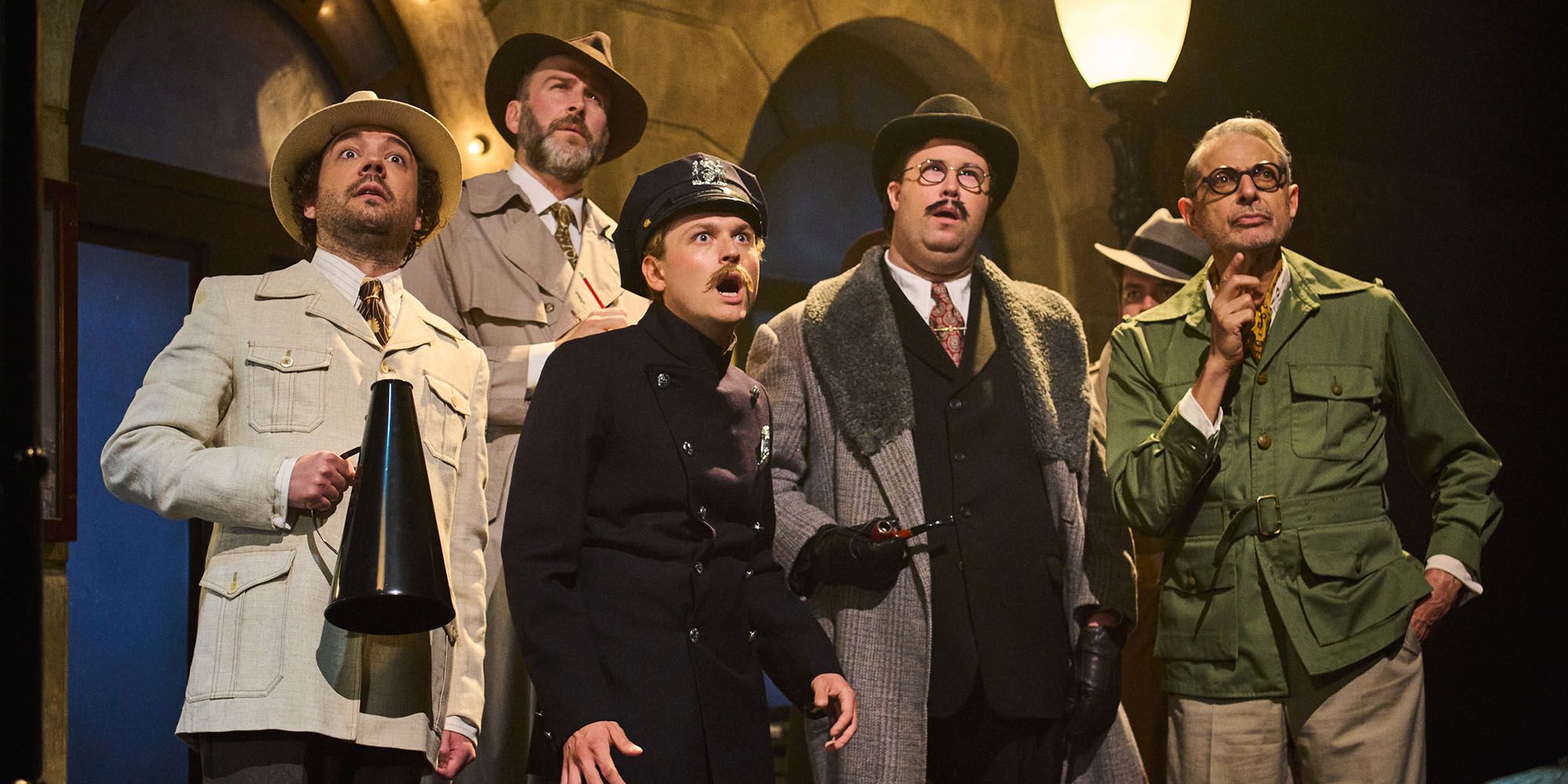
These limits have encouraged U.S. writers to use innuendo, euphemism, interrupted sentences, and bleeps. The audience anticipates a curse word and laughs at the cast’s attempts to conceal it. Those devices can also make a confrontational sketch feel oddly sanitized. British writers can instead have a character respond with an obscenity, making the dialogue sound more spontaneous — think Al Nash shouting “What the fuck?” to Jeff Goldblum in "An Invisible Friend".
There is still debate about how far the production team wants to push those boundaries. The Season 1 premiere sparked an internal discussion about how far to take the language during a sketch about William Shakespeare returning home from London with a Gen Z personality. Helen Kruger Bratt, Managing Director, Universal Television Alternative Studio UK Productions, told delegates at the Edinburgh TV Festival that when deciding to use the c-bomb, it “turns out using a Y at the end of it makes it totally acceptable.” So George Fouracres was allowed to use the phrase “cunty little earring!”
British comedy has a long tradition of bluntness, social embarrassment, and elaborate insults. Its best uses of profanity reveal character. In the political satire The Thick of It, Malcolm Tucker’s (Peter Capaldi) foul insults are almost poetic in their construction. “Come the fuck in or fuck the fuck off” is funny not simply because it contains profanity, but because of its rhythm. The language establishes him as a man who regards himself as the most competent person in the room and everyone else as an obstacle to be shouted into submission.
Peep Show uses profanity too. Mark (David Mitchell) and Jeremy (Robert Webb) swear in ways that expose their insecurity, selfishness, and inability to manage ordinary life. Mark’s internal commentary is often far more vicious than anything he would dare say aloud, while Jeremy is more openly vulgar. Much of the humor comes from the gap between what the characters think and what they actually say, so the language belongs to their personalities rather than feeling like an attempt to shock the audience.
Bowen Yang, who recently left the Saturday Night Live cast, argues that the show would benefit from being allowed to swear. On an episode of his podcast Las Culturistas with Amy Poehler, he proposed that the cast should be allowed “at least five shits and five fucks” per season to take a sketch “to the next level” by making it feel more like the real world rather than a heightened sketch reality. Poehler, however, offered a counterargument. She suggested that there is something fun about not being able to say a word, because the restriction creates comic tension. Once the character says it, the tension may disappear, and the joke may lose some of its force. Relaxing the restrictions might make some sketches more realistic, but it could also sacrifice devices the writers have honed across 52 seasons.
The first episode of SNL UK addressed this tension during the monologue — American host Tina Fey got to deliver the first swear word of the British version. Explaining to Bridgerton actor Nicola Coughlan why a U.S. host had been chosen for the premiere, Fey said, “None of you fuckers would do it.” In SNL’s self-deprecating style, Michael Cera raised his hand to question her language. Fey’s “fucker” got a laugh, but Cera’s embarrassed retort — “Shitbird!” — got an even bigger one. His awkward delivery made the exchange work, although both performers still used profanity.
Some social media users argue that the British show has a comic advantage simply because it can swear. But its strongest moments do not necessarily depend on profanity. The recent comparisons around Weekend Update are particularly revealing too. The British version with Paddy Young and Ania Magliano has made sharp and controversial jokes, including around the Ed Sheeran/Macklemore controversy that do not use profanity. Those jokes show how pointed the British version can be without relying on strong language.
There is also a practical reason to use fewer swear words: SNL reaches audiences beyond live television. Sketches are shared online, watched out of context and circulated across platforms with different audiences and rules. The British version’s reach may depend partly on how well its sketches travel through social media and YouTube, especially as Sky’s live audience figures are less impressive than the online attention suggests. Strong language may need to be bleeped or edited in some clips, potentially affecting how easily a sketch can be shared.
Saturday Night Live UK should continue to embrace its freedom to swear when it makes a joke land harder, to make a character feel more real or a situation more absurd. The American version has spent decades finding comedy in what it cannot say. The British SNL now has the opportunity to find comedy in what it can, without turning that freedom into an obligation.
Saturday Night Live UK premieres on Saturdays in the U.K. on Sky One and streams the next day on Peacock in the U.S.